How To Regulate The Nervous System
Metacognition is thinking about your own thinking. For example, someone with complex PTSD might notice that certain thoughts or memories trigger intense anxiety. They reflect on how they respond and choose to use grounding techniques or self-soothing strategies instead of reacting automatically. By observing their own thought patterns and adjusting their responses, they are practising metacognition.
Becoming aware of our metacognition is important because it enables us to step outside our immediate experience and see what our mind is doing. This creates freedom, clarity, and choice rather than automatic reactions.
Here are the key reasons:
You stop running on autopilot.
When you notice your thoughts, emotions, and reactions as they happen, you are no longer driven by old habits, fears, or unconscious patterns.
You regulate emotions more effectively.
Metacognition helps you recognise what you are feeling and why, which allows you to calm yourself, pause, or respond differently.
You make better decisions.
When you can observe your thinking, you can question assumptions, check for distortions, and choose what is right for you.
You understand yourself more deeply. It enhances self-awareness, which is crucial for healing, growth, and healthy relationships.
You break trauma-driven patterns.
Trauma often pulls people into automatic survival responses.
Metacognition allows you to notice those responses and gently shift them instead of being controlled by them.
You learn more efficiently. By watching how your mind works, you can improve how you learn, think, and solve problems.
You develop psychological flexibility.
This is the foundation of resilience. You become able to adapt, reflect, and choose new ways of responding.
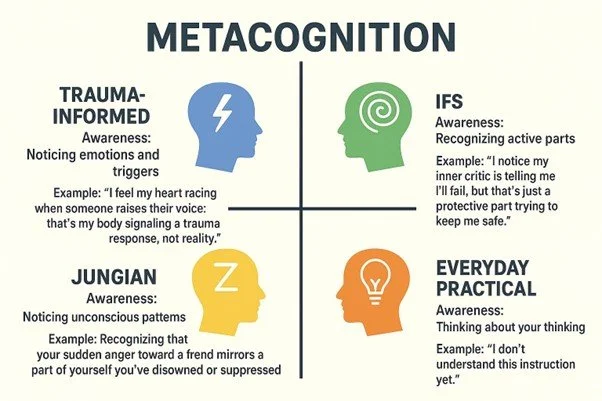
Metacognition can be understood through four different perspectives: trauma-informed, IFS (Internal Family Systems), Jungian, and everyday practical examples.
1. Trauma-Informed Perspective
Trauma can disrupt metacognition because it affects the brain’s ability to self-reflect and regulate emotions.
Awareness: Trauma survivors may find it hard to notice what they are feeling or thinking in the moment.
Regulation: The fight, flight, freeze response can hijack thinking, making planning or evaluating difficult.
Practical insight: Therapy can help restore metacognitive skills, like noticing triggers, pausing before reacting, and reflecting on emotional responses.
Example: A survivor notices, “I feel my heart racing when someone raises their voice; that is my body signalling a trauma response, not reality.”
2. Internal Family Systems (IFS) Perspective
IFS sees the mind as made up of parts that have distinct roles.
Metacognition is the Self observing the parts. Awareness: Recognising when a part is active, such as a critic, protector, or exile.
Regulation: The Self can guide parts to cooperate rather than being controlled by them.
Practical insight: Metacognition in IFS is essentially the Self being the inner leader, noticing which parts are influencing thoughts and behaviours.
Example: “I notice my inner critic is telling me I will fail, but that is just a protective part trying to keep me safe.”
3. Jungian Perspective
Jung emphasised conscious and unconscious layers. Metacognition is linked to conscious reflection on unconscious patterns.
Awareness: Noticing projections, shadow elements, and recurring complexes.
Regulation: Integrating shadow parts rather than acting unconsciously through them.
Practical insight: Metacognition is part of individuation, gaining conscious control over unconscious drives.
Example: Recognising that your sudden anger toward a friend mirrors a part of yourself you have disowned or suppressed.
4. Everyday Practical Examples
Metacognition is simply thinking about your thinking in daily life. Awareness: “I do not understand this instruction yet.” Regulation: “I will read it again more slowly and take notes.”
Evaluation: “This method worked; next time I should try summarising it in my own words.”
Other daily uses include studying more efficiently, planning work tasks, managing emotions, such as noticing “I am anxious because I am rushing; I need a break,” and making decisions, such as asking yourself “Why do I feel drawn to this choice and what am I overlooking?”
“If you’d like to explore this topic further with me, you’re welcome to get in touch through my webpage. I hope this has been helpful and useful in your own reflections and healing.”