Living Fully: What Individuation Really Means
Trauma, Shadow, and the Slow Return to Inner Authority
The long road to individuation is not a concept only learned in books — it’s lived, step by step, through experience, mistakes, grief, and small victories. This post is about what I’ve discovered on that journey and how those lessons can be shared, or “paid forward,” to help others move a little closer to themselves.
Individuation is one of those Jungian concepts that is frequently mentioned but rarely understood. Many imagine it as stepping away from society, rejecting norms, or chasing some rarefied, exceptional self. In reality, individuation is quieter, slower, and far more demanding.
It’s not about leaving life behind.
It’s about learning to live fully without abandoning yourself.
Jung described individuation as the gradual alignment of consciousness with the deeper centre of the psyche — the Self. This journey doesn’t excuse us from responsibility, structure, or ordinary life. In fact, it usually calls for more of all three.
Individuation Is Integration, Not Escape
Individuation doesn’t start with bold self-expression.
It starts with recognition.
Specifically, it begins when you can start to see the difference between:
• who you became to survive
• and who you really are beneath those adaptations
For many, especially those who experienced early trauma, this awareness isn’t immediately freeing. It can feel destabilising. Survival strategies work — they keep life running. Letting them go too quickly can feel unsafe.
That’s why individuation is often mistaken for rebellion or withdrawal. Really, it’s a conservative process at first. It protects what’s necessary while gently loosening what no longer serves.
A Personal Note
For a long time, I thought individuation meant breaking away from life’s expectations, societal pressures, or systems that felt confining. What I eventually learned was different and uncomfortable.
The work wasn’t about escaping society. It was about noticing how much of my inner life had been organised around safety instead of truth. That safety came at a cost: muted self-trust, delayed creativity, and a persistent sense of living beside my own life rather than inside it.
Individuation didn’t arrive as freedom.
It arrived as grief.
Grief for time lost, for capacities muted, for the self that learned to stay small to survive. Later, something else emerged: a quieter sense of authority — not confidence exactly, but coherence.
Trauma Work Is Not Individuation (But It Makes It Possible)
This distinction matters.
Trauma work is about stabilisation, regulation, and repair.
Individuation is about integration and meaning.
They are connected, but not the same. When the nervous system is on high alert, the psyche’s energy is devoted to defence. Jung understood that the ego must be strong enough to safely meet the unconscious. Without that safety, growth can overwhelm rather than heal.
In practice:
• Trauma work helps the psyche feel safe enough to exist
• Individuation begins when the psyche has enough safety to ask deeper questions
Many people feel “stuck” not because they haven’t reflected enough, but because they haven’t built enough containment — in relationships, finances, body, or environment.
Individuation is not a replacement for trauma work. It’s what becomes possible once safety is established.
Lilith, the Sun, and Over-Adaptation
Astrology can give us a symbolic lens on these processes. Take Lilith square the Sun. Psychologically, it often reflects tension between the socially viable self (the Sun) and instinctual, autonomous parts of the psyche that were disowned early (Lilith).
This isn’t about rebellion. Often, it points to over-adaptation — a self shaped to fit conditions that didn’t allow full expression.
Individuation in this context isn’t about unleashing the suppressed. It’s about bringing it into dialogue with consciousness. The shadow doesn’t need to dominate life; it needs a place at the table.
Individuation and Society
One of Jung’s most misunderstood ideas is that individuation removes a person from society. He actually warned that those who haven’t individuated are more vulnerable to collective pressures — ideology, groupthink, moral outsourcing.
Individuation doesn’t remove us.
It allows us to participate without being consumed.
An individuated life can look ordinary. What changes is the source of authority. Choices aren’t guided solely by fear of exclusion or approval, but by an internal sense of coherence.
It’s not easier.
It’s truer.
The Unromantic Reality of Individuation
Individuation is rarely dramatic. More often, it feels frustrating before it feels meaningful.
It looks like:
• clarity replacing fantasy
• limits replacing grand narratives
• honesty replacing identity
Over time, something stabilising emerges: the sense that your life, however constrained or unfinished, is no longer fundamentally false.
This is not about withdrawal.
It is psychological adulthood.
Closing
Individuation isn’t about being exceptional.
It’s about ending the quiet contradictions in your own life.
It’s slow, deliberate work, and deeply ethical, and in a culture that prizes performance over truth, that may be its most important contribution.
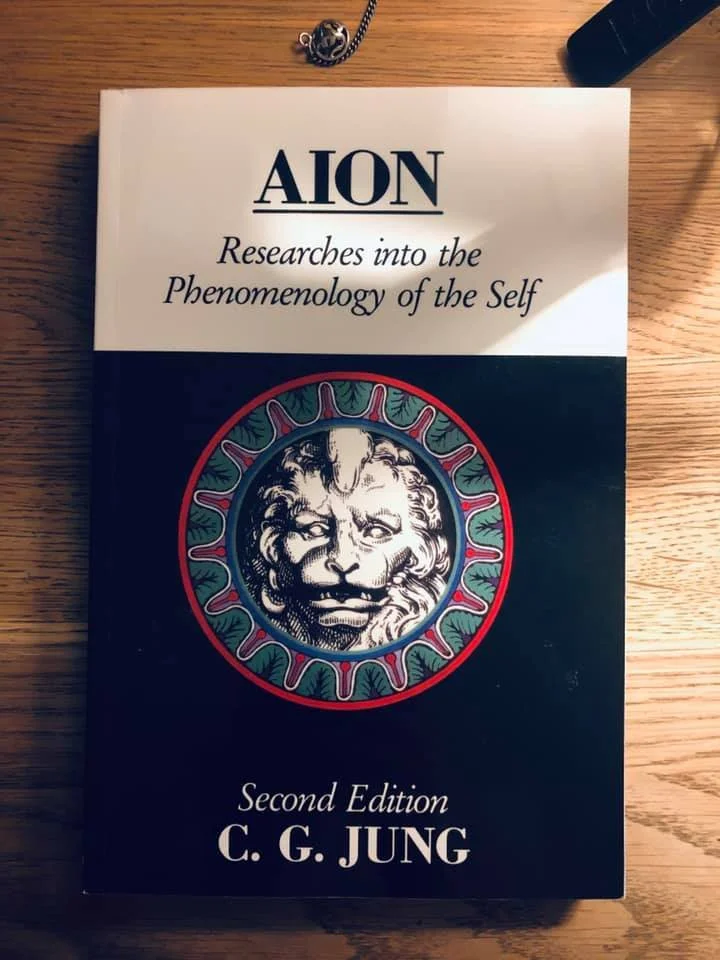
Photo of Aion a photo of a book I own by Jung