When Truth-Tellers Are Cast as Enemies
Why societies reject uncomfortable voices and reframe them as threats…
“In times of uncertainty, anxiety, and terror - self-affirming fantasy is the only refuge and truthtellers are cast as demonic foes.” - Sam Vaknin
I saw the above post by Sam Vaknin on his Instagram today, about a psychological defence mechanism that operates both individually and collectively.
“Self-affirming fantasy” refers to the stories we tell ourselves (or that a group tells itself) to preserve a sense of safety, superiority, or coherence when reality feels unbearable. It’s not just wishful thinking; it’s an identity-protective narrative. Think of it as the psyche’s emergency shelter.
“The only refuge” is the key phrase. When anxiety reaches a certain pitch, when genuine uncertainty can no longer be metabolised, the ego can no longer tolerate ambiguity. It can’t hold complexity. So it retreats into a closed, self-confirming loop. “Truthtellers are cast as demonic foes” is where it gets really sharp. Anyone who introduces reality, nuance, contradiction, or unwelcome fact is experienced not as helpful but as threatening. They puncture the fantasy. So they must be expelled, discredited, or demonised. The messenger becomes the danger.
It maps very closely onto Jungian shadow dynamics: what cannot be integrated gets projected outward as an enemy. The truthteller carries the shadow of the group’s own suppressed doubt.
It’s also deeply relevant in this context; this is precisely the mechanism that allows perpetrators and institutions to sustain their own narratives, and why witnesses who speak are so often attacked. The truth doesn’t just inconvenience; it terrifies, because it destabilises the entire defensive structure.
Vaknin is essentially describing collective narcissistic injury under pressure. The stronger the terror, the more totalising the fantasy, and the more violently the reality-tester is rejected.
A narcissistic injury is any threat to the self-image that the ego cannot absorb.
The term comes from psychoanalysis and refers to a wound to the sense of self, specifically to the idealised image a person (or group) holds of themselves. It doesn’t require clinical narcissism to experience one. We all have a version of ourselves we need to believe in to function, and when that image is seriously challenged, the injury can feel catastrophic rather than merely uncomfortable.
What makes it narcissistic specifically is that the threat isn’t to physical safety or practical circumstances; it’s to the story of who we are. Our goodness, our specialness, our coherence as a self.
The response to narcissistic injury tends to follow a recognisable pattern: shame first (which is intolerable), then a rapid conversion of that shame into rage, blame, or grandiosity. The person doesn’t say “I was wrong.” They say “you are attacking me,” or “you are evil,” because that reframe restores the self-image.
In the context of the Vaknin quote, the narcissistic injury is the terror itself, the uncertainty that reveals the self or the group as not in control, not safe, not as powerful as believed. The self-affirming fantasy is the attempt at repair. And the truthteller is injured because they re-open the wound just as it’s being plastered over.
It also connects my reading of The Inner World of Trauma directly to what Kalsched describes too; the self-care system that becomes persecutory. The psyche’s attempt to protect itself becomes the very thing that imprisons it.
The more a system depends on fantasy for its stability, the more dangerous reality becomes.
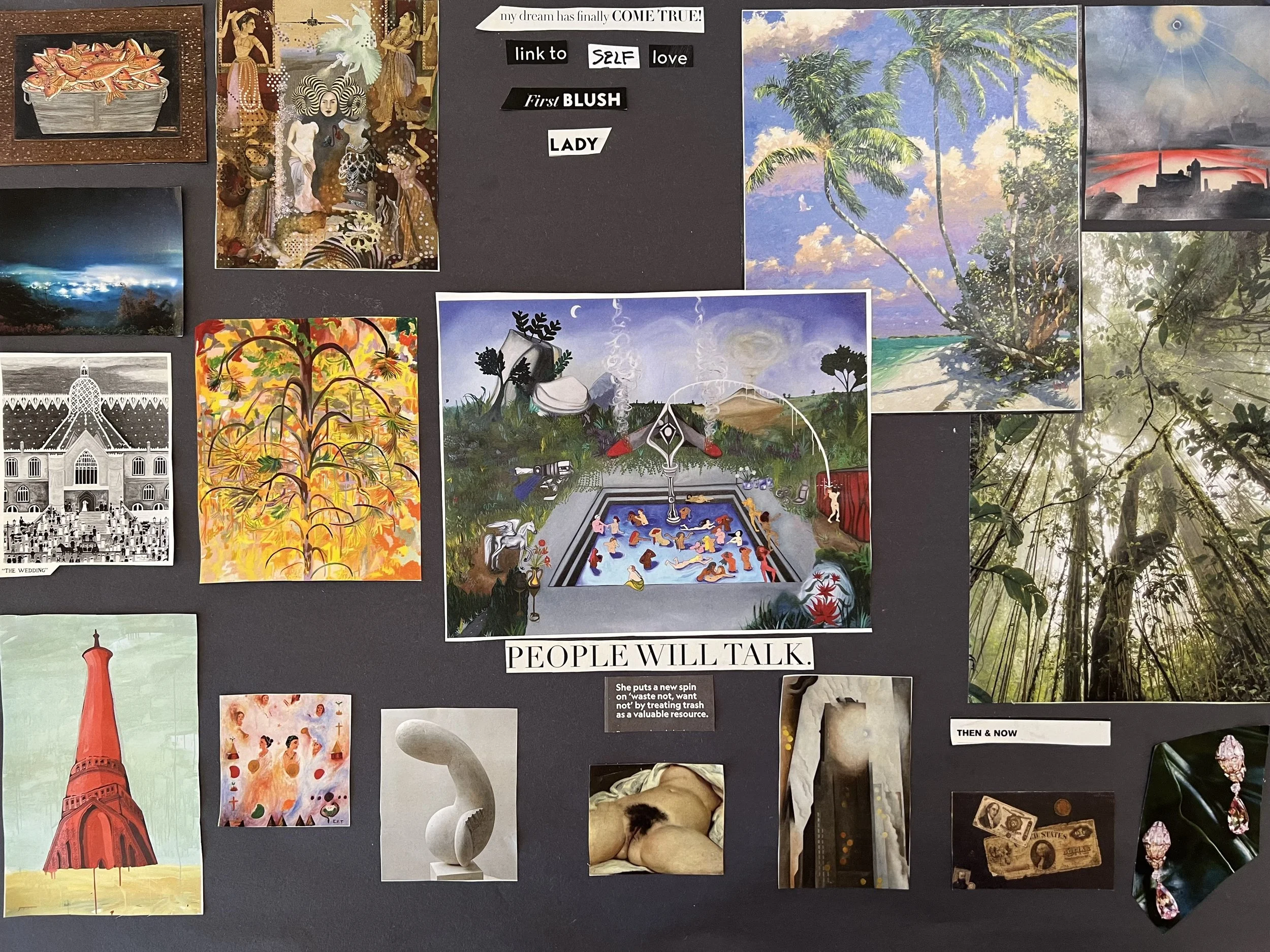
Collage Art by me, January 2025, Mount Madonna, California, under the instruction of Coeleen Kiebert … Images from various old magazines, including National Geographic.