The Power of Speaking Truth
I just finished listening to The Psychology of Totalitarianism by Desmet on Audible, and it had a really good effect on me. It spoke my language and made a lot of what I’ve been thinking about feel clearer.
One thing that really hit me is his idea that what controls people isn’t always force. It can be something far less visible: a shared silence, a narrowing of what can be said, a subtle pressure that shapes what feels possible to speak. Desmet writes about mass formation, how groups can get caught up in a dominant narrative, and how dissenting voices don’t necessarily break that narrative, but they do something just as important by stopping it from becoming absolute. He gives the example of experiments on mice under stress, whose immune systems were weakened simply by being in a stressful environment, showing how stress can take over our bodies, minds, and even decision-making faculties without us noticing. We can see how fear works in the real world too, like during COVID, when constant fear-mongering, uncertainty, and intense media narratives created anxiety that affected people physically, emotionally, and socially, shaping what they felt was possible or safe to do.
While he’s talking about societies, I kept thinking about something closer to home in the human experience: how truth can be silenced in more intimate, hidden systems. Child sexual abuse is one of those realities that has existed for a very long time, often in plain sight in family homes, and yet somehow not fully seen. Not because people can’t understand it, but because it’s hard for many to face squarely.
There’s a kind of social discomfort around it: looking away, quiet minimising, sometimes an inability to take in the scale or impact. And in that space, something forms—not a political totalitarian system, but a closed psychological environment where truth struggles to land, where speaking can feel dangerous, and silence becomes the safer option.
Desmet’s emphasis on voice really stuck with me. Not force, not dominance, but voice. Speaking calmly and truthfully has an effect even when it doesn’t appear to change anything on the surface. It interrupts something. It prevents a complete collapse into silence.
I think that applies here too. One of the most damaging aspects of abuse is not only what happens, but what happens around it: not being believed, not being heard, the sense that reality itself becomes unstable. Speaking, whether publicly, privately, or even internally at first, is not just an expression. It is orientation. It’s a way of saying: this is real.
Speaking up can feel scary for many of us. It’s worth asking ourselves: what are we afraid of? I know from experience that even as a child, I spoke up and was punished or silenced further. As an adult, I will continue to speak up because I know it makes a difference.
This isn’t about forcing awareness or overwhelming anyone. It’s subtle. It’s about letting truth exist in the open, without distortion. Without exaggeration, but also without minimisation. Change doesn’t happen all at once. It happens gradually, through people willing to speak the truth in a way that can be heard.
Truth doesn’t need to be loud to be powerful. But it does need to be spoken. It can happen quietly, imperfectly, even when it feels like it changes very little. The act of speaking up, over time, changes things. Each voice matters. And with that knowing, we can begin to speak and keep speaking because it is in the act of speaking that change quietly begins.
The next book I’m planning to listen to on Audible is The War of Art by Stephen Pressfield. I was inspired to pick it up after hearing Dan Millman, who wrote Way of the Warrior, mention it in an interview. One question he referred to from the book—“What are you afraid of?”—feels especially useful when facing discomfort in life. I’ll share an update on that book next week if I feel it’s useful.
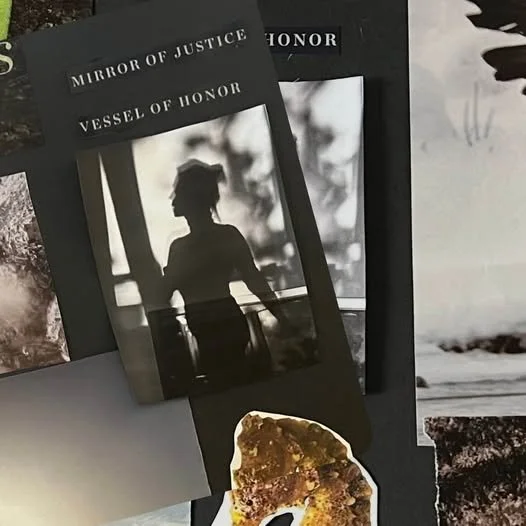
Collage Art by me 2026
Penelope Ryder is a Hypnotherapist, astrologer, mentor, and writer completing a book on trauma and survival. She writes about psychology, astrology and the inner life at Substack www.peneloperyder.com